
“Then Pilate therefore took Jesus, and scourged him” —John 19;1
Just three words… the mind absorbs them in a second and passes to the next sentence. The Bible gives no further explanation. There is no parenthetical statement or footnote explaining what scourged means. Most of us read over it for years without really contemplating that word. It was somehow a part of the crucifixion. Maybe we heard a preacher say it was some sort of a whipping. Oh, but it was so much more.
Governor Pilate knew the Jews delivered Jesus out of envy (Mt. 27: 18), and that He had committed no real crime, certainly not one worthy of death (Lk. 23:15). This cagey politician also knew that something had to be done. These folks were too worked up to go home without any action, so he decided a scourging might satisfy their lust for vengeance (Jn. 19:1, cf. 19:5).
DEFINITION AND LIMITATIONS. These were not civilized people by modern standards. Today’s Humane Society would not allow a dog to be treated the way our Lord was. Scourging (or “examination by scourging,” Acts 22:24,29) was a legal preliminary to every Roman execution. This brutal flogging was called the “little death” and normally preceded the “big death”— crucifixion. Only women, Roman senators, and soldiers (except deserters) were exempt. A criminal was flogged either by two soldiers (lictors) or by one who alternated positions. Under Hebrew law, punishment was limited to thirty-nine strokes, but the Romans imposed no count limitation. A scourging’s severity depended entirely on the lictor’s disposition. His only limitation was that the man must not die at the scourging stake. He was to expire on the cross. Soldiers became proficient at bringing victims to the verge of collapse, without crossing death’s threshold.
INSTRUMENTS. The scourging post was two feet high. An iron ring was placed close to the top. The usual instrument was a short-handled whip (flagrum or flagellum) with several single or braided thongs of variable lengths, in which small iron balls or sharp sheep bones were tied at varying intervals. Sometimes several thin, iron chains, which ended in small weights were added.
PREPARATION. A prisoner was stripped and stood naked, or at the most with a loincloth, (Is it any wonder the Bible says that Jesus “…endured the cross, despising the shame…” Heb. 12:2?) The man’s wrists were firmly shackled to the iron rings, and he was stretched, face down, with his feet pointed away from the post. The tension of awaiting the first blow was cruel. The body was rigid. The muscles knotted in tormenting cramps. Color drained from the cheeks. Lips were drawn tight against the teeth.
SCOURGING. Then it came… the whistle of the whip and the dull thud as it made contact with flesh. Then it came…the burning sensation and the first trickle of blood. Then it came…again and again, more rapidly, blow after blow. Then it came… with seemingly unbearable agony, the naked back, neck, sometimes face, chest, and stomach (as the whip was allowed to encircle the body), buttocks, and legs were repeatedly struck. At first, it caused deep contusions (bruising). Then, as the lictor continued in his gruesome work, the thongs, bones, and weights cut into the skin, subcutaneous tissue, and even muscle. After a while, the victim’s body twitched like a beheaded chicken. The lacerations finally tore into the underlying skeletal muscles and produced quivering ribbons of bleeding flesh. As V.P. Black puts it, “They beat Jesus until His shoulder blades looked like two whitecaps on an ocean of blood.” The victim lost all consciousness to anything other than the blinding, burning pain as the cruel whip whistled and cut, whistled and cut. A scourging was the literal equivalent of’ being flayed alive. Some men bit their tongues off as the pain grew unbearable. Few men remained conscious till the end.
THE RESULTS. After what seemed like an eternity to the victim and those who loved Him, the limp body was cut from the post. Customarily, wounds were washed but not medicated. The pain and blood loss caused by scourging generally led to circulatory shock. The “bloody sweat” (hematidrosis) experienced in the Garden had likely rendered Jesus’ skin very tender, The physical and mental abuse meted out by the Jews and Romans, as well as the lack of foods water, and sleep, contributed to a generally weakened state, Thus, by modern-day criteria, if at that time Jesus had been admitted to a hospital, He would have been put into intensive or critical care (Mk. 15:15, 20). The severity of this condition usually pre-determined that the victim would not survive too long on the cross.
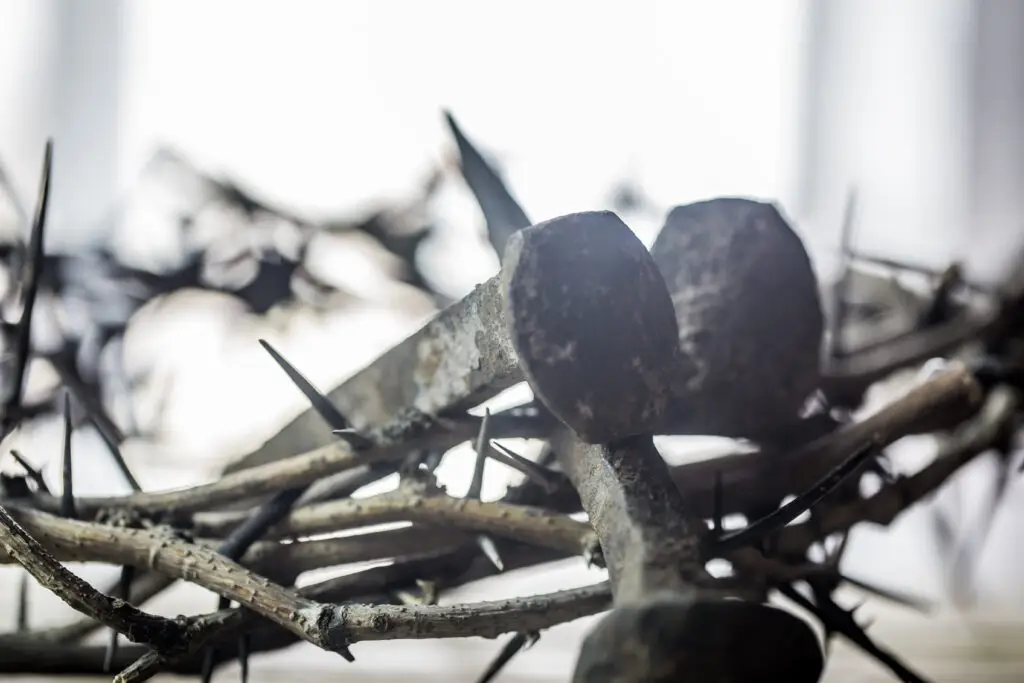
ADDING INSULT TO INJURY. In this case, Jesus’ clothes were put back on the massacred back. Imagine how the seamless garment must have soaked up that precious blood. How uncomfortable its rough scratching on His open wounds must have been! The soldiers, amused at this weakened man who claimed to be a king, mocked Him. One quickly fashioned a robe out of purple cloth (perhaps they used the robe Herod had earlier put on Him); another ran out to a thorn bush to gather prickly limbs to make the tight, pointed circle of a crown; another found a stout stick of some kind to use as a scepter.
One soldier grabbed His head and forced the thorns down over His scalp. The sharp thorns pierced His skin in dozens of places and tore gashes as the crown was forced down his brow. Someone hit Him over the head with the rod, driving the thorns in more deeply. How He must have bled! (So much blood goes to the brain that a small cut that it bleeds profusely.) Just about the time the blood began to clot, and His clothing became stiff with blood, a soldier ripped off His clothes and placed on Him the robe—thus opening the wounds again. Imagine how that must have hurt! Even a small area covered by a bandage hurts terribly if it adheres itself to the strip.
The soldiers finally had all the fun they wanted and took Him back to Pilate, who presented Him to the people. Picture Pilate leading this purple-clad Man, with scepter in hand, and bloody crown on His head, out for these sick people to view. Pilate said simply, “Behold the man!” (Jn, 19:5). He must have thought that surely this would satisfy their hatred. But he underestimated them. They were no more satisfied than a shark that first gets the scent of blood. They wanted more. They wanted murder.
Why did Jesus go through this? He didn’t have to. He could have gone back to heaven in a chariot of fire. He could have snapped His fingers for angels to rush to His defense. Why? Because He wanted us to be saved (Lk. 19:10). Are you? Have you responded to His sacrifice? If not, in a sense, He went through it for nothing. He still invites, “Come unto me…” (Mt. 11:28). Why not accept his proffered gift in penitent faith and be baptized to reenact His death, burial, and resurrection (Rm. 6:3, 4; Acts 2:38; 22:16).
“Surely he hath borne our griefs and carried our sorrows: yet we did esteem him stricken, smitten of God, and afflicted. But he was wounded for our transgressions, he was bruised for our iniquities; the chastisement of our peace was upon him; and with his stripes we are healed.” (Isa. 53:4-5).


